
 Xbox Cloud Gaming Equirements: Internet, Devices, Controllers
  How to Delete Sent Messages on iPhone From Both Sides
  Real-Time Tracking in the Distribution of Goods
  Portable Monitor For Laptop Guide
  Optimizing Sales Prospecting with Modern Software Tools
  What Is One Way That Technology Can Improve The Distribution Of Goods?
  Xbox Cloud gaming: A Practical Guide For Real Life
  Game Pass vs PlayStation Plus: which is actually worth it?
  Macfox X1S installation guide: assembly, setup, and first ride checks
What is one way that technology can improve the distribution of goods?
One way that technology can improve the distribution of goods is by giving businesses real-time information about inventory, shipments, vehicles, and delivery conditions. That visibility helps teams reduce delays, reroute deliveries when necessary, prevent stockouts, and communicate better with customers. If a truck is late, a pallet is missing, or a warehouse is falling behind, the business can respond faster because it knows what is happening while it is happening.
That may not sound dramatic, but it changes a lot. Without timely data, decisions come too late. With timely data, a distribution manager can adjust delivery schedules, move stock between locations, notify buyers, or shift labor where it is needed most. In many operations, that is the difference between a manageable delay and a much bigger service failure.
Real-time visibility is also a gateway improvement. Once a business starts collecting better operational data, it can improve other parts of distribution too. This is where the conversation gets more interesting, because technology is not just one tool. It is a connected system of software, sensors, automation, analytics, and communication platforms working together.
Why distribution breaks down so easily
The distribution of goods sounds straightforward on paper: receive products, store them, move them, deliver them. In reality, it is full of friction. Inventory counts are wrong. Drivers hit traffic. Weather changes routes. Warehouse teams run short on staff. Orders spike unexpectedly. Different systems fail to share information. And sometimes, to be fair, everyone is doing their job and things still get messy.
That is why distribution problems are rarely caused by one dramatic mistake. They usually come from small gaps stacking up over time. A late inbound shipment causes a picking delay. That delay changes dispatch timing. Dispatch timing affects route efficiency. The customer gets a vague ETA, then calls support. Support does not have the latest information. Suddenly a basic order becomes a chain of avoidable problems.
Technology improves distribution by reducing those gaps. It gives teams faster access to facts, automates repetitive work, and helps different parts of the operation stay aligned. I think this is where many articles oversimplify the topic. The real value is not just speed. It is coordination.
Real-time visibility changes everything
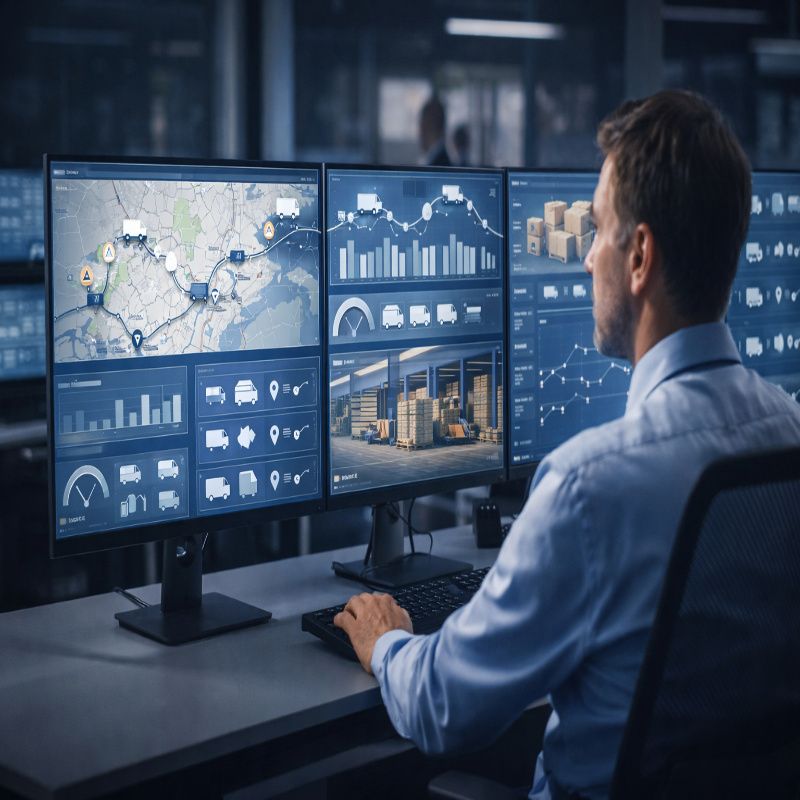
When people ask what is one way that technology can improve the distribution of goods, real-time visibility is still the best starting point because it connects so many operational decisions. GPS systems show where delivery vehicles are. RFID tags and barcode systems show where products move inside warehouses. Inventory software shows stock levels across locations. Customer-facing platforms update delivery status without forcing someone to make a phone call every ten minutes.
These tools make distribution more transparent. Managers can see whether a shipment left on time, whether a warehouse fulfilled the right order, or whether a delivery route is falling behind schedule. That matters because delays are not always preventable, but unmanaged delays are usually worse than necessary.
If this topic is central to your content strategy, it makes sense to support this section with a separate cluster piece on real-time tracking in the distribution of goods. That article can go deeper into GPS, RFID, telematics, and shipment alerts without overloading the main pillar page.
How real-time tracking improves decisions
Let’s say a vehicle is running behind because of congestion or a mechanical problem. In a low-visibility operation, the issue might only be discovered after the promised delivery window has already passed. In a more connected system, dispatchers can spot the delay early, update the route, notify the customer, or send another vehicle if the shipment is urgent. That kind of response protects both service quality and trust.
The same idea applies inside the warehouse. If inventory is updated in real time, staff are less likely to sell stock that is not actually available. If scanning systems confirm product movement at each stage, businesses reduce picking errors and improve order accuracy. None of this is glamorous, exactly. But it is the kind of operational consistency that customers notice even when they do not see it.
Route optimization makes distribution faster
Another major way technology improves the distribution of goods is through route optimization. Once a business knows where goods are, the next question is how to move them more efficiently. Route planning software helps companies choose faster, lower-cost, and more reliable delivery paths based on traffic, distance, customer time windows, delivery priority, and vehicle capacity.
Older route planning often relied on local knowledge and manual scheduling. There is still value in experience, obviously. A seasoned dispatcher often knows things software misses. But software can process far more variables at once and recalculate quickly when conditions change. That makes a real difference in last-mile delivery, regional distribution, and multi-stop fleet operations.
This deserves its own supporting article as well, so the pillar can link naturally to a deeper guide on route optimization for the distribution of goods. That cluster piece can explore dynamic routing, fuel efficiency, delivery windows, and dispatch strategy in more detail.
What route optimization actually solves
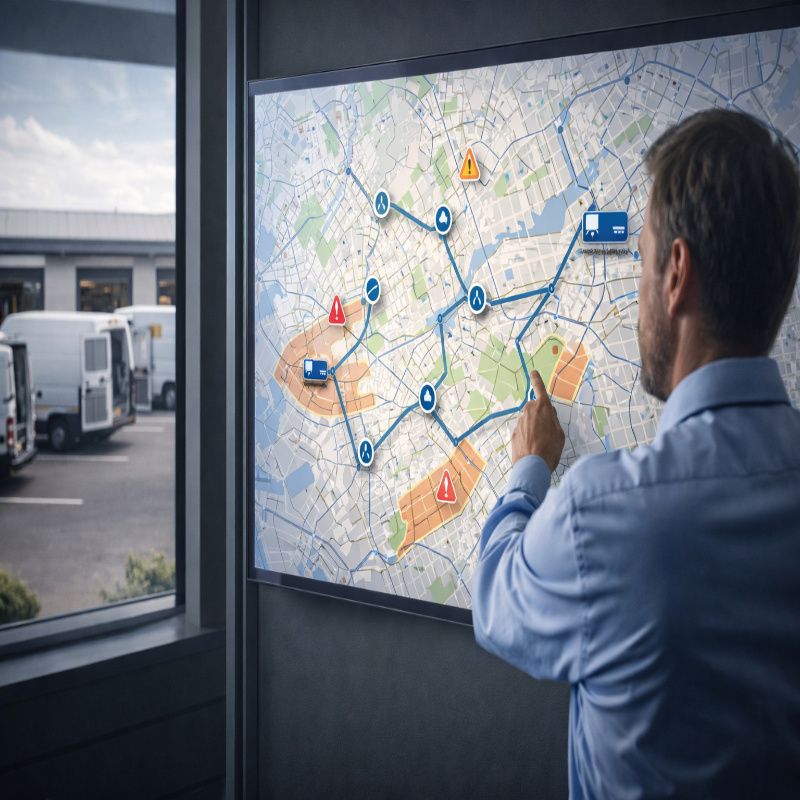
Route optimization is not just about finding the shortest route on a map. It helps solve a wider set of business problems: missed delivery windows, underused vehicles, high fuel costs, inefficient stop order, and dispatch plans that break down when conditions change. In other words, it improves both speed and structure.
For example, if one driver has too many stops and another has spare capacity, smart routing software can rebalance the workload. If weather or road closures disrupt a planned route, the system can suggest alternatives. If a customer changes a delivery time, the route can be adjusted without rebuilding the whole plan from scratch. That flexibility is one reason technology has become so important in modern logistics.
Inventory technology reduces costly mistakes
Distribution does not fail only on the road. Quite often, it fails before goods even leave the building. Inventory management systems help businesses track stock levels, locations, reorder points, and item movement more accurately. When inventory data is wrong, companies overpromise, underdeliver, and waste labor searching for products that should have been easy to find.
Good inventory technology creates a more reliable picture of what is actually available. That may involve barcode scanning, RFID tags, cloud-based inventory platforms, or automated stock updates tied to order management systems. However it is built, the benefit is clarity. Teams can fulfill orders faster because they trust the data in front of them.
This becomes even more important when businesses operate across multiple storage locations. A company may have stock in a central warehouse, a local hub, a retail site, and a third-party logistics facility all at once. Without integrated inventory tools, it is surprisingly easy to make bad fulfillment decisions. With stronger visibility, the business can allocate stock more intelligently and reduce avoidable delays.
Why inventory accuracy matters more than people think
Inventory errors often look small at first. Maybe one unit is miscounted, one scan is skipped, or one replenishment threshold is set too low. But these mistakes spread. A wrong stock count can trigger an unnecessary purchase order, delay an urgent shipment, or force customer service teams to explain why an item that showed as available is suddenly unavailable.
That is why inventory software is not just an administrative tool. It directly affects distribution speed, labor efficiency, and customer satisfaction. In some businesses, improving inventory accuracy alone can remove a surprising amount of operational stress. Not all of it, unfortunately, but a lot.
Warehouse automation speeds up fulfillment
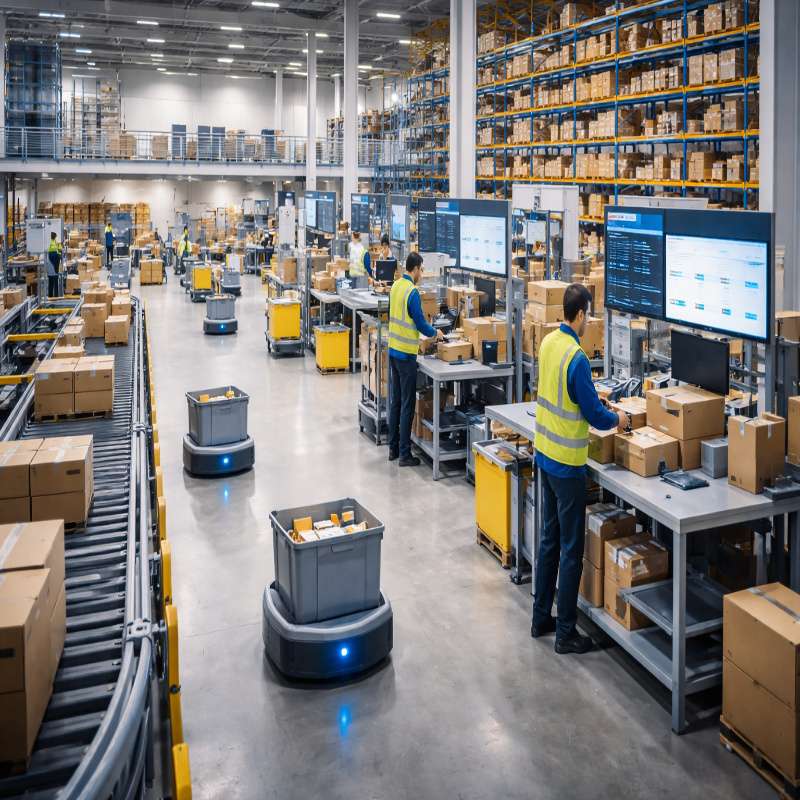
Warehouse operations are at the center of distribution, and technology has transformed them in practical ways. Warehouse management systems, mobile scanners, automated picking tools, robotics, conveyor systems, and digital task assignment all help move orders through the facility with fewer delays and fewer errors.
Some businesses hear the word automation and immediately imagine expensive robots replacing entire teams. That can happen in highly advanced operations, but most warehouse automation is much more ordinary than that. It might be software assigning picking routes, scanners reducing manual entry, or systems grouping orders more efficiently. Small improvements add up.
A related cluster post on warehouse automation in the distribution of goods would fit naturally here. It can explain the difference between basic warehouse software, semi-automated processes, and more advanced fulfillment technology.
Warehouse management systems and workflow control
A warehouse management system, or WMS, gives managers better control over receiving, putaway, storage, picking, packing, and shipping. It helps direct labor, track item locations, and reduce wasted motion on the warehouse floor. In many cases, the biggest gain is not just speed but consistency.
Think of a warehouse where workers are constantly hunting for inventory, checking paper sheets, and correcting avoidable mistakes. Then compare that with a facility where tasks are assigned digitally, product locations are updated automatically, and every movement is recorded through scanning. The second operation is not flawless, but it is easier to manage, easier to measure, and easier to improve over time.
Analytics helps businesses plan instead of react
One of the quieter ways technology improves distribution is through data analysis. Real-time tools help teams respond to immediate issues, but analytics helps them see patterns over weeks, months, and seasons. That includes demand trends, recurring delivery delays, warehouse bottlenecks, inventory turnover rates, and route performance.
With better analytics, businesses can plan labor more accurately, stock the right products in the right locations, and identify which distribution processes are consistently underperforming. This is where technology starts moving from operational support to strategic advantage. It helps leaders make decisions based on evidence instead of habit.
Predictive analytics goes one step further by using historical and current data to forecast what is likely to happen next. A business can estimate demand surges, identify which routes tend to fail under certain conditions, or forecast when inventory is likely to run low. Forecasts are never perfect. Still, a useful estimate is often far better than a blind guess.
From reports to better action
Data does not improve distribution on its own. That sounds obvious, but companies sometimes invest in dashboards and still struggle because nobody changes behavior. The real value comes when analytics shape practical decisions, such as adjusting reorder points, redesigning routes, changing shift schedules, or moving fast-selling inventory closer to demand centers.
In that sense, technology is not really replacing judgment. It is sharpening it. Human decision-making still matters, perhaps more than ever. The difference is that better systems give people a stronger starting point.
Communication tools improve the customer experience
Distribution is not only about moving products efficiently. It is also about keeping customers informed. Technology helps here through automated order confirmations, delivery notifications, self-service tracking pages, proof-of-delivery systems, and customer service tools connected to live shipment data.
This matters because customers usually tolerate delays better when communication is clear. What frustrates them is uncertainty. If they do not know whether an order shipped, where it is, or when it will arrive, trust starts to drop quickly. A simple status update can prevent a lot of unnecessary support contacts.
For businesses, this has a secondary benefit. Better customer communication reduces pressure on service teams because customers can find updates themselves. It also creates a more professional experience overall, which matters whether you are shipping industrial equipment, retail goods, or ecommerce orders.
Integration is where the real gains happen
Single tools help, but connected systems help more. A route optimizer is useful. A warehouse system is useful. A delivery tracking platform is useful. But the real gains appear when these tools share data. If inventory levels update the order system, the order system feeds the warehouse, the warehouse updates dispatch, and dispatch pushes delivery status to the customer, the whole distribution flow becomes more coherent.
That is the part many simple articles leave out. Technology does not improve distribution just because software exists. It improves distribution when information moves smoothly between systems and people. Otherwise, companies end up with isolated tools and fragmented decisions. It looks modern on the surface, but it still feels chaotic underneath.
This is also why implementation matters almost as much as tool selection. A basic system that is well integrated can outperform an expensive system that nobody uses properly. I have seen versions of that problem in plenty of industries. The software gets blamed, but the real issue is usually process design or poor adoption.
Common challenges when adopting distribution technology
Technology can improve the distribution of goods, but the path is not always smooth. Some businesses struggle with upfront costs. Others have older systems that do not connect well with newer platforms. In some warehouses, staff training becomes the real bottleneck. In others, data quality is poor, so the system produces fast answers built on weak information.
There is also the human side of change. Teams may resist new tools if they feel those tools are confusing, unnecessary, or imposed without context. That reaction is understandable. If a company wants better adoption, it needs to explain not just how a system works but why it matters. People tend to support changes more readily when they can see the operational payoff.
Another issue is overbuying. Businesses sometimes invest in oversized platforms packed with features they do not need. A smaller, focused solution can be more effective if it solves the right problem well. It is tempting to think the most advanced option must be the best one, but in distribution, fit often matters more than complexity.
Examples of technology improving distribution in practice
Imagine an ecommerce company that ships hundreds of orders a day from a regional warehouse. Before upgrading its systems, the team relies on spreadsheets, manual stock counts, and fixed delivery routes. Orders are often delayed because inventory data is out of date and dispatch planning is slow. Customer service spends much of the day answering “Where is my order?” emails.
Now imagine the same business after adopting barcode scanning, cloud inventory software, route planning tools, and customer tracking notifications. Stock updates are more accurate. Orders are picked faster. Drivers follow routes that adapt to actual conditions. Customers receive automatic delivery updates. No single change fixes everything, but together they make the operation more reliable and much easier to manage.
Or take a wholesale distributor serving multiple retail locations. With integrated demand and inventory data, the business can move fast-selling products to the right hubs before shortages begin. That reduces emergency transfers, improves fill rates, and gives planners more confidence in replenishment decisions. Again, the technology is useful because it supports better timing and better coordination.
How to choose the right technology for distribution
It is easy to chase trends in this space: artificial intelligence, robotics, blockchain, predictive engines, digital twins. Some of those tools are genuinely useful. Some are useful only in specific environments. And some are adopted because they sound impressive in a board meeting. A better starting point is much less glamorous: identify the actual bottleneck first.
If late deliveries are the problem, focus on route planning, telematics, and live delivery tracking. If stockouts are the issue, invest in inventory visibility and replenishment systems. If warehouse throughput is too slow, look at WMS capabilities, scanning tools, layout changes, and workflow automation. In other words, match the technology to the pain point.
Businesses should also think about ease of integration, employee training, reporting quality, vendor support, and long-term flexibility. The best technology is not necessarily the newest. It is the one that improves the process clearly enough that people keep using it six months later.
Why this topic matters for the future of logistics
Distribution is becoming more complex, not less. Customer expectations are rising, delivery windows are narrowing, product assortments are expanding, and supply chains are facing more disruption than many businesses were built to handle. Technology is not a complete answer to all of that. But it is one of the few practical ways to build more resilient, responsive distribution systems.
What is one way that technology can improve the distribution of goods? Real-time visibility is still the strongest simple answer. Yet once you follow that answer far enough, you start to see the bigger picture. Better visibility leads to better routing. Better routing supports faster delivery. Better inventory data supports smarter fulfillment. Better integration supports better decisions across the whole chain.
And that, really, is the point. Technology improves distribution not by adding complexity for its own sake, but by helping businesses move goods with more accuracy, more speed, and fewer avoidable surprises. For companies trying to grow without losing control of operations, that is not just useful. It is essential.