
 Xbox Cloud Gaming Equirements: Internet, Devices, Controllers
  How to Delete Sent Messages on iPhone From Both Sides
  Real-Time Tracking in the Distribution of Goods
  Portable Monitor For Laptop Guide
  Optimizing Sales Prospecting with Modern Software Tools
  What Is One Way That Technology Can Improve The Distribution Of Goods?
  Xbox Cloud gaming: A Practical Guide For Real Life
  Game Pass vs PlayStation Plus: which is actually worth it?
  Macfox X1S installation guide: assembly, setup, and first ride checks
If you’ve been searching for marvel rivals ranks, there’s a good chance you’ve run into the same problem I have: every guide tells you the list of tiers, but the moment you need a practical answer (like who can queue together, or why your points feel “sticky”), things get vague fast. So this is a genuinely complete, keep-it-open-while-you-play guide to Competitive—built for real humans who just want clarity, not lore.
A quick note before we jump in. Some ranked rules in Marvel Rivals have shifted between seasons, and even reputable outlets occasionally contradict each other. When that happens, this guide leans on the most consistent, widely reported rules, and flags the “verify in-client” items so you don’t build your whole climb on one outdated line of text.
Marvel Rivals Competitive, in plain English
Competitive in Marvel Rivals is the ranked ladder. You win, you earn rank points, you climb divisions and tiers. You lose, you usually drop points—unless a protection mechanic kicks in (more on Chrono Shield in a minute). The ladder itself is consistent across sources: there are nine main ranks, and most of them have three divisions.
If you’re planning to queue with friends, don’t skip the party rules section. It’s the number-one reason people get blocked at the “Ready” button and start guessing.
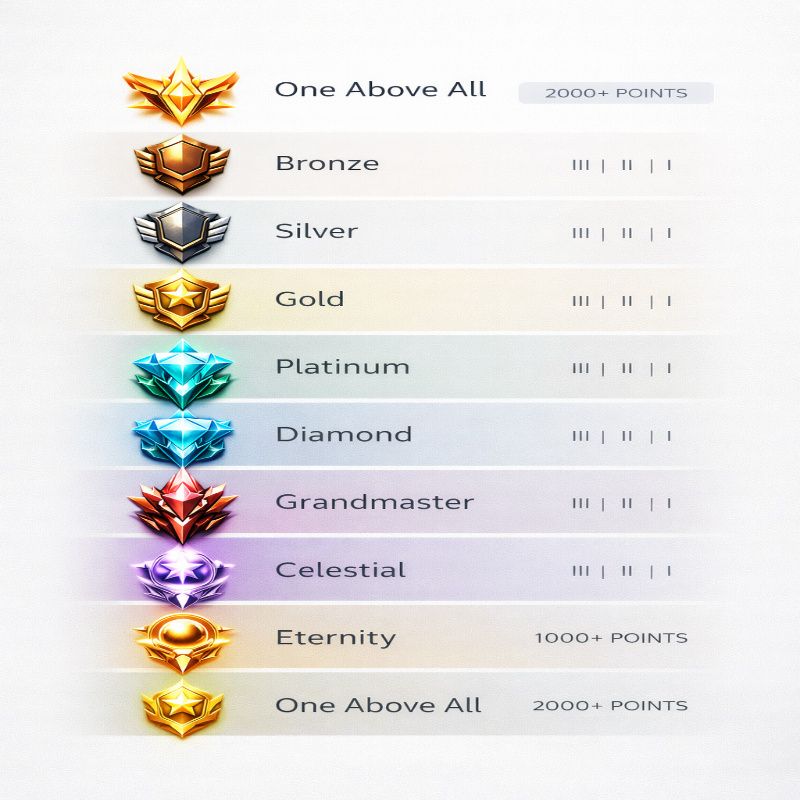
marvel rivals ranks in order (all tiers)
Here are the nine competitive ranks in Marvel Rivals, from lowest to highest:
- Bronze (III, II, I)
- Silver (III, II, I)
- Gold (III, II, I)
- Platinum (III, II, I)
- Diamond (III, II, I)
- Grandmaster (III, II, I)
- Celestial (III, II, I)
- Eternity (points-based)
- One Above All (points-based, limited to the top 500 players)
This exact structure—especially the “III to I” divisions through Celestial and the point-based nature of Eternity/One Above All—shows up repeatedly across major guides. PCGamesN, for example, lists the same nine ranks and notes that One Above All is limited to the top 500. TechRadar uses the same ordering and frames Eternity/One Above All as “rack up points.”
Why divisions exist (and why you should care)
Divisions (III, II, I) are basically short checkpoints inside each rank. They’re not just cosmetic. In practice, divisions help matchmaking and make progress feel less like a single endless bar. And yes, it also means you can be “Gold” and still be far apart from another “Gold,” which matters for queue restrictions later.
How rank points work (the part most guides rush)
Most coverage describes Marvel Rivals as using a points system where you progress in chunks per division, commonly reported as 100 points per division. That means you don’t just “become Gold” instantly—you typically move through Gold III to Gold II to Gold I, each at a 100-point step, before you promote to Platinum. PCGamesN describes this structure explicitly (100 per tier, 300 per full rank band).
Now, here’s the slightly annoying truth: the exact amount of points you gain or lose per match can vary. It’s not always a fixed “+20/-20.” Guides tend to avoid hard numbers for a reason. It can be influenced by matchmaking, streaks, and possibly performance, and the game doesn’t always spell it out in a clean formula.
How many points to rank up?
As a working mental model (and honestly, the one that keeps you sane), assume 100 points advances you one division. Hit the threshold, you move up. Fall far enough, you drop. It’s simple, and it matches how multiple publications describe the ladder’s structure.
If you want a deeper breakdown of how ranked points generally behave and how to avoid “wasting” good sessions, there’s a dedicated guide here:how Marvel Rivals ranked points work.
Chrono Shield: ranked protection that can change your climb
The Chrono Shield is one of those mechanics that sounds minor until it saves a night where everything is going wrong. IGN describes Chrono Shield as a ranked mechanic meant to prevent de-ranking by protecting you from losing points after your next loss, with an important limitation: Chrono Shields only work in Gold rank and below, and you can’t get that protection in Platinum and above.
That “Gold and below” detail matters because it quietly changes the vibe of climbing. In lower ranks, one bad match can be “absorbed.” In Platinum+, losses tend to feel harsher because they’re not cushioned the same way.
There’s also reporting around Chrono Shield Cards—an item tied to activating the shield—covered by outlets like Times of India, including the idea that these cards can be season-limited. If your audience cares about ranked integrity, this is worth mentioning carefully, without turning it into drama.
What ranks can play together in Marvel Rivals?
This is where most people get stuck, especially when one friend is grinding and the other is playing casually. GamesRadar lays out a clear set of party restrictions, and it’s one of the more actionable explanations out there.
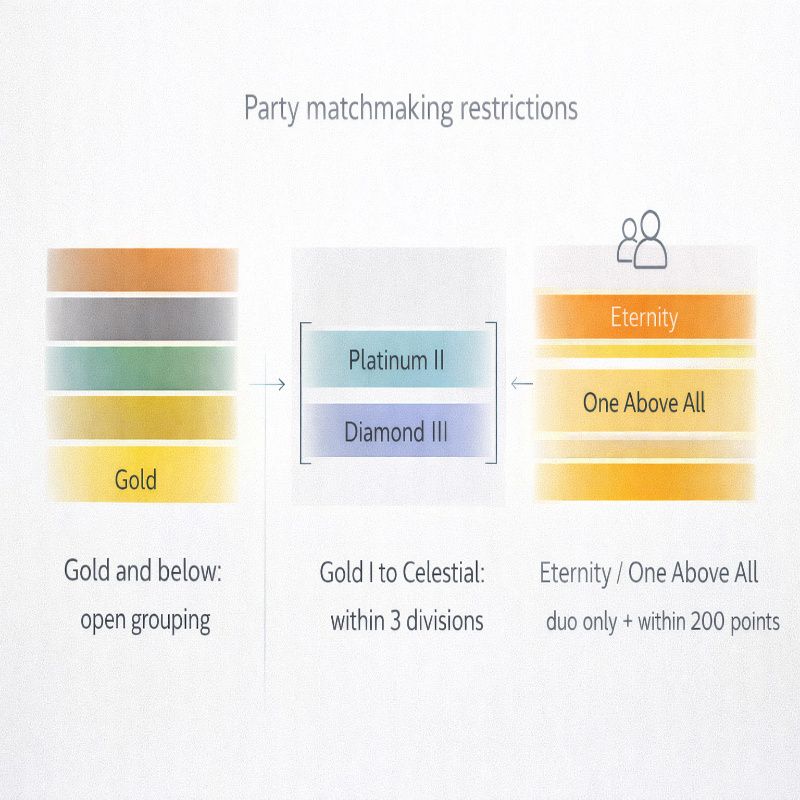
Gold and below: generally flexible
Multiple sources describe Gold and below as essentially unrestricted for grouping. Esports Insider and other guides commonly present Gold as the cutoff where things start tightening, which matches what many players experience in practice.
Gold I through Celestial: the “three divisions” rule
GamesRadar describes that from Gold I through Celestial, you can only group within three divisions of each other. So, for example, Platinum II and Diamond III is typically fine (three divisions apart). Platinum II and Diamond I? That’s where you start hitting the wall.
If you want a quick, example-heavy version you can send to friends without them reading this whole pillar, link them here:what ranks can play together in Marvel Rivals.
Eternity and One Above All: stricter rules (and fewer options)
At the top end, restrictions get more specific. GamesRadar notes that Eternity and One Above All players can only duo queue, and it also mentions a 200-rank-points condition when queuing with high Celestial players. In other words, “close in rank” stops being a vibe and becomes math.
It’s a little frustrating if your group is big—but it also makes sense. High-rank matchmaking is trying to stay competitive, and big skill gaps (or big coordinated stacks) can distort it.

Hero bans: when do they start?
Hero bans are a classic “this is where ranked gets serious” feature, and—oddly—this is also an area where published guides can conflict. Some sources describe bans appearing once lobbies are high enough, but they don’t always agree on the exact threshold. For example, Eloboss states that once all players in a match are Diamond III or above, each team can ban a hero before the match starts.
Because this threshold can be season-dependent (and because the “bans start at X rank” line is exactly the sort of thing that gets changed quietly), the best practice for a high-trust guide is: treat Diamond III+ as a commonly reported trigger, but advise readers to confirm the current rule in the Competitive lobby UI or patch notes.
Rank distribution: what “average” looks like
People love to ask, “Is Platinum good?” and honestly, it depends. But rank distribution gives you at least a rough social comparison—just don’t treat it as universal truth, because distributions shift over a season and can vary by platform/region.
PCGamesN published a January 2026 snapshot of rank distribution that looks like this: Bronze 25.5%, Silver 10.2%, Gold 12.6%, Platinum 13.6%, Diamond 15.4%, Grandmaster 15%, Celestial 6.4%, and Eternity + One Above All combined 1.6%.
For an alternate, more “live stats” style view, RivalsTracker-style sites also publish distribution breakdowns (including splits by individual divisions), though you should always label these clearly as third-party data.
How to climb without burning out
This is the part where guides usually become motivational posters. Let’s not do that. Climbing is mostly about consistency and decision-making—plus a bit of patience for matchmaking variance.
- Play in focused blocks. Two clean sessions a week often beats seven tired sessions.
- Queue with a compatible partner when you can. Duo synergy is real, and top ranks often restrict you to duo anyway.
- Stop after a tilt streak. That sounds obvious, but in practice it’s the #1 “I wish I’d logged off earlier” lesson.
- Track one improvement metric. Not ten. Pick one: objective uptime, deaths per game, ultimate timing, or role discipline.
If you want the more technical version of this—especially how ranked points and thresholds interact with your habits—bookmark this:Marvel Rivals ranked points guide.

Competitive unlock requirements (and what to do if ranked is locked)
This is a surprisingly messy topic online. Some guides have referenced Competitive unlocking at a specific account level (and different sources have reported different levels in different seasons), so it’s best to treat the exact unlock requirement as a “check in-client” item rather than a permanent truth.
What you can do right now is reduce friction for readers: explain where Competitive is in the menu, what modes count toward leveling, and what common blockers look like (account level, tutorial completion, or party members who don’t meet requirements).
A separate, update-friendly post helps here because the unlock requirement is the kind of detail that changes and makes an otherwise great pillar look outdated. This is the dedicated walkthrough:Marvel Rivals Competitive unlock requirements.
FAQ
How many ranks are in Marvel Rivals?
Most major guides list nine: Bronze, Silver, Gold, Platinum, Diamond, Grandmaster, Celestial, Eternity, and One Above All.
Is One Above All a real rank or just a leaderboard?
It’s typically described as an apex rank limited to the top 500 players, and it’s points-based rather than divided into III/II/I subdivisions.
Do Chrono Shields work in Platinum?
IGN notes Chrono Shields only work in Gold and below, and that Platinum and above cannot receive Chrono Protection.
Can I queue with friends at higher ranks?
Yes, but it becomes more restricted. GamesRadar describes grouping within three divisions from Gold I through Celestial, then stricter rules (including duo-only at the top and point-based limits) for Eternity and One Above All.
Conclusion: using marvel rivals ranks to plan your climb
At a glance, marvel rivals ranks look simple—Bronze through One Above All—but the details that actually shape your experience are the ones people skip: division thresholds, Chrono Shield behavior, and party restrictions. If you treat the ladder like a system (not a mood), climbing gets less mysterious, even when matchmaking is weird.
If you’re queuing with friends, start with the party restrictions guide and save yourself the frustration. If you’re climbing solo, focus on understanding points and protecting your mental energy as much as your rank.
And one last thing—maybe obvious, but still worth saying: keep an eye on season updates. Ranked rules can shift. A guide that stays current is, quietly, a competitive advantage.